
Pipeline reviews dominate the sales calendar. Every week or fortnight, the team walks through deals, stages, and forecast. What rarely gets the same attention is the account base itself. The relationships the deals come from, the trajectory of each significant customer, the early signals of churn or growth that show up well before they reach the pipeline. That’s the account review, and most businesses don’t run one in any structured way.
An account review is an internal, structured assessment of each significant customer relationship: where it stands, where it’s heading, and where the gaps are. It’s a different exercise from a QBR, which is customer-facing, and from a pipeline review, which only looks at open opportunities. Where pipeline reviews handle the foreground, account reviews examine the foundation.
What an Account Review Should Actually Surface
The value lies in the signals an account review picks up that a pipeline review can’t:
📉 Decline signals, where revenue has trended down, contact frequency has dropped, or engagement has narrowed to a single person
🌱 Opportunity signals, where white space, cross-sell potential, or growth in the account’s own market hasn’t been acted on
👥 Relationship health, where the entire commercial relationship sits with one contact and leaves the business exposed if that person leaves
⚠️ Risk patterns, where complaint history, payment behaviour, and support intensity together signal an account becoming expensive to serve
🎯 Commercial direction, where the data points to which accounts to invest in, which to maintain, and which to deprioritise
None of these surface in a deal-by-deal pipeline review. They only emerge when the account is examined as a unit.
Why Most Businesses Don’t Run Them
Three reasons.
Pipeline reviews crowd the calendar. Deal-by-deal conversations feel more urgent because deals are time-bound and the forecast is on the line. Account reviews don’t carry the same week-to-week pressure, so they get pushed back indefinitely.
There’s no obvious framework. Leaders know roughly what a pipeline review looks like. The same can’t be said of account reviews, so even when the value is recognised, the practical question of what to actually do in one stalls the conversation before it starts.
The data lives in different places. Revenue per account is usually in finance. Contact engagement is in the CRM. Support intensity is in a ticketing system. Complaints are in someone’s email. Without an account-level view that pulls these together, the review either can’t really happen, or it turns into a manual spreadsheet exercise nobody wants to repeat.
What the CRM Needs to Hold
Account reviews only produce useful conversations when the CRM gives an account-level picture, not just a deal-level one. The minimum the system needs to surface:
💷 Revenue trend per account over the last 12 to 24 months
📞 Contact engagement frequency and recent changes in pattern
🧑🤝🧑 Stakeholder spread, showing whether the relationship sits with one contact or several
📊 Open opportunities alongside closed history, so the future and the past sit on the same page
🛠️ Service or support patterns where those systems are connected to the CRM
Most CRMs hold the underlying data. What they typically don’t do is present it at account level. That structural change, pulling these dimensions together into a single account view, is what makes account reviews possible without a weekly spreadsheet exercise.
Where to Start
Pick the top 10 to 20 accounts by revenue, current and potential. Run a structured review on each one quarterly. Use a simple framework:
- Where is this account today? Current revenue, key contacts, recent activity, open opportunities.
- Where is it heading? Trend across the last 12 months: growing, holding, declining, or at risk.
- What’s the biggest risk? One-contact dependency, declining activity, complaint pattern, payment issue.
- What’s the biggest opportunity? White space, expansion territory, cross-sell, deeper engagement.
- What specific action follows? A named owner, a timeline, and a follow-up scheduled for the next review.
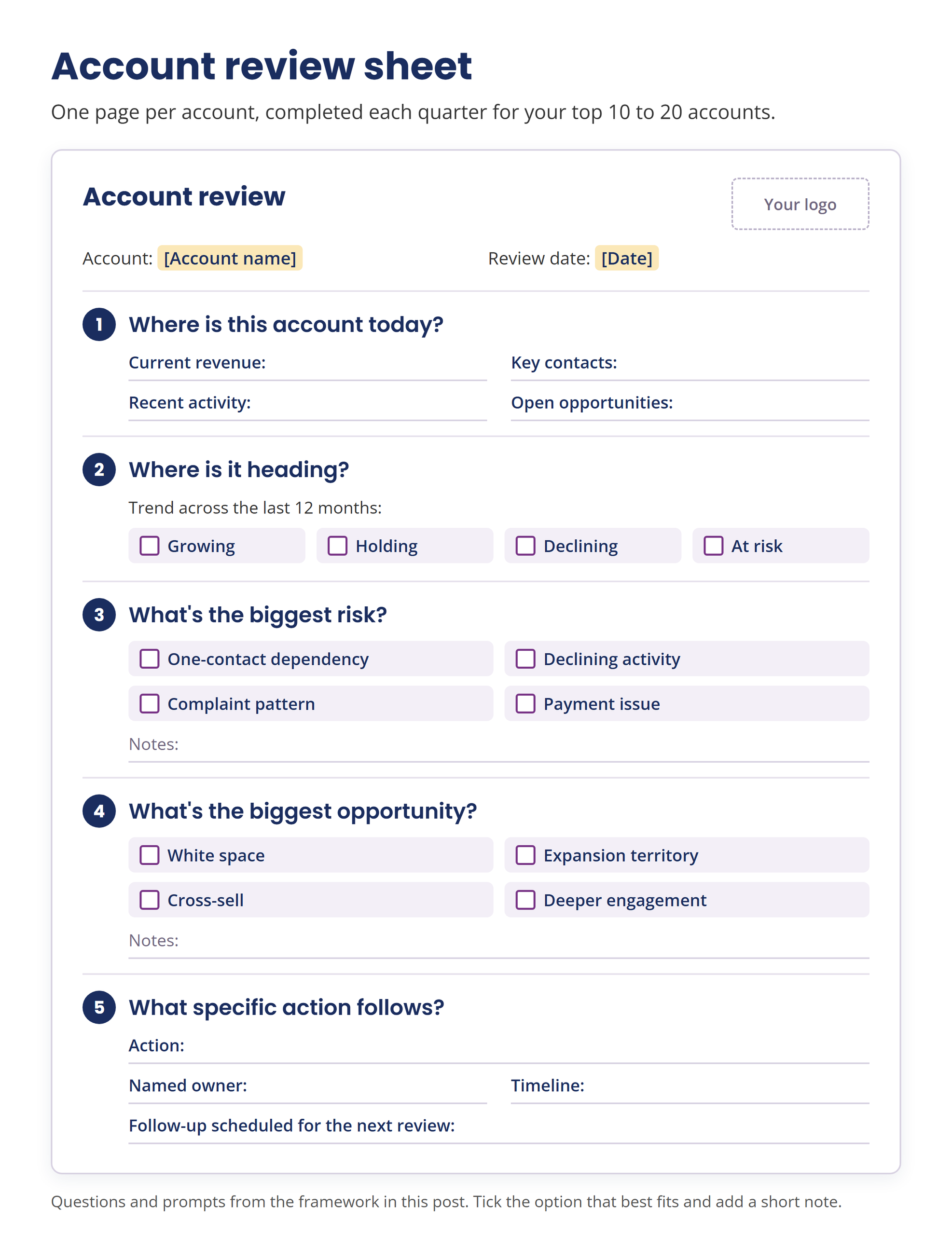
That’s a real account review. Held even once, it usually surfaces enough to justify making it a habit.
If you’d like to see what an account-level view in a CRM looks like in practice, book a demo with the BuddyCRM team.