
Many sales teams have a rep who consistently hits target, owns the biggest accounts, and runs things their own way. Their CRM records are thin, but nobody minds, because the results are there and performance buys latitude.
The outcome is quiet but significant, because the strongest commercial relationships in the business can end up the least documented. It also tends to go unquestioned precisely because the rep is doing well.
Why It’s a Commercial Risk
The instinct is to treat it as a personality trait, a strong performer with their own style. Looked at commercially, it means the value that rep generates is real but tied to them personally rather than held by the business, and that exposes more than it first appears:
- 🔑 Key accounts whose history, context, and relationships exist only in one person’s head
- 📉 No early warning if one of those accounts starts to cool, because the signals were never logged
- 🤝 A negotiating position that quietly shifts toward the rep, who knows the business can’t easily step in
- 🧩 Managers who can’t coach or support deals they have no visibility into
- ⏳ A dependency that compounds the longer it runs, as more accounts accumulate under the same blind spot
Why It Persists
The situation continues because everyone is incentivised to leave it alone.
The rep has no reason to change a system that works for them. The manager doesn’t want to disrupt a top performer or pick a fight they might lose. Leadership sees the results and assumes the commercial picture underneath is sound.
Nothing about it feels like a problem until something forces it into view, whether that’s a missed signal on a key account, a renewal that quietly lapses, or the rep handing in their notice. By the time the gap becomes visible, the cost is already real.
Reframing the Conversation
The usual response is to push for better CRM discipline. That lands as criticism of someone who’s performing, and it rarely sticks.
A more useful reframe is to treat documentation as part of how the business protects and compounds commercial value, rather than as administrative compliance. Instead of asking a top rep “why won’t you use the CRM properly?”, the better question is “how do we make sure the value you’re building belongs to the business as well as to you?”
That’s a different conversation, and a strong rep tends to respond to it differently. It respects what they’ve built while making clear that the business needs a share in it.
The Structural Fix
Repeated reminders to update the CRM rarely change much, so the more durable answer lies in system design. The aim is to make capturing what matters the path of least resistance, and to make the expectation structural rather than personal:
- 🧱 Field and pipeline design that ties what gets recorded to specific points in the sales process, so context is captured as a deal progresses rather than added afterwards as admin
- 👥 Account ownership models where significant accounts have a business-level owner alongside the rep, so no relationship sits entirely off-system
- 📋 Routine account reviews that make under-documented key accounts visible as a matter of course
- 🎯 A consistent standard for what must be captured on high-value accounts, applied to everyone regardless of performance
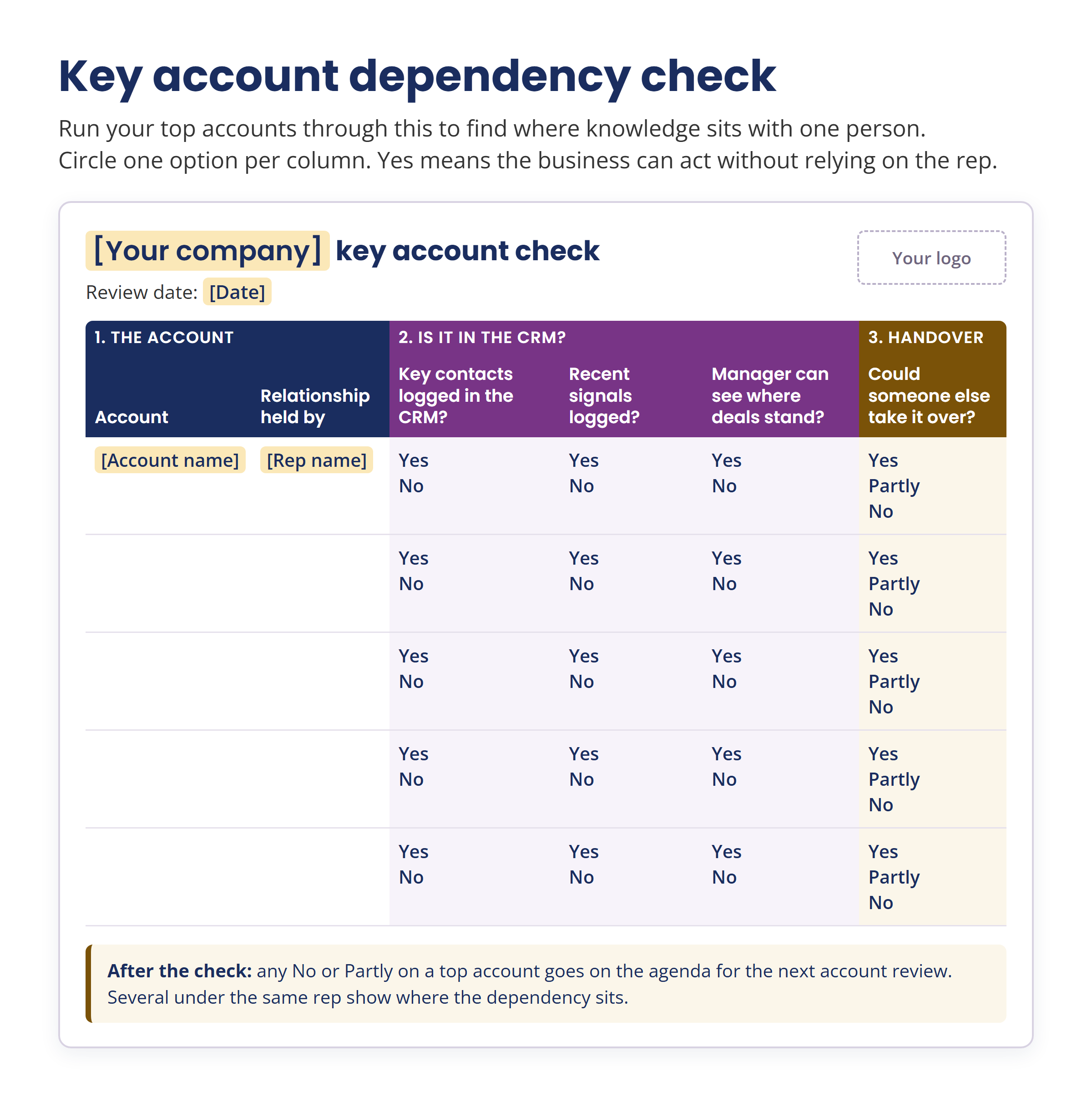
A quick way to see where the exposure sits today is to run your top accounts through a short dependency check, then take anything that fails it into the next account review.
What Strong Teams Do Differently
Well-run teams back their most valuable relationships with structure as well as trust, building a system where performance and documentation work together and a top rep’s success leaves a trail the business can build on. That protects the rep’s results and the company’s commercial base at the same time, which is a better outcome for everyone than a blind spot nobody wanted to mention.
Book a demo with the BuddyCRM team to look at how your key accounts are held. We can review where commercial context sits on your highest-value accounts, how fields and account ownership are set up, and what it would take for that knowledge to stay with the business.